Readers researching rodin ai for figurine creation can use this Hyper3D and SupaVoxel comparison to understand the difference between a printable starting mesh and a convincing digital rear view. Rodin AI itself is not tested.
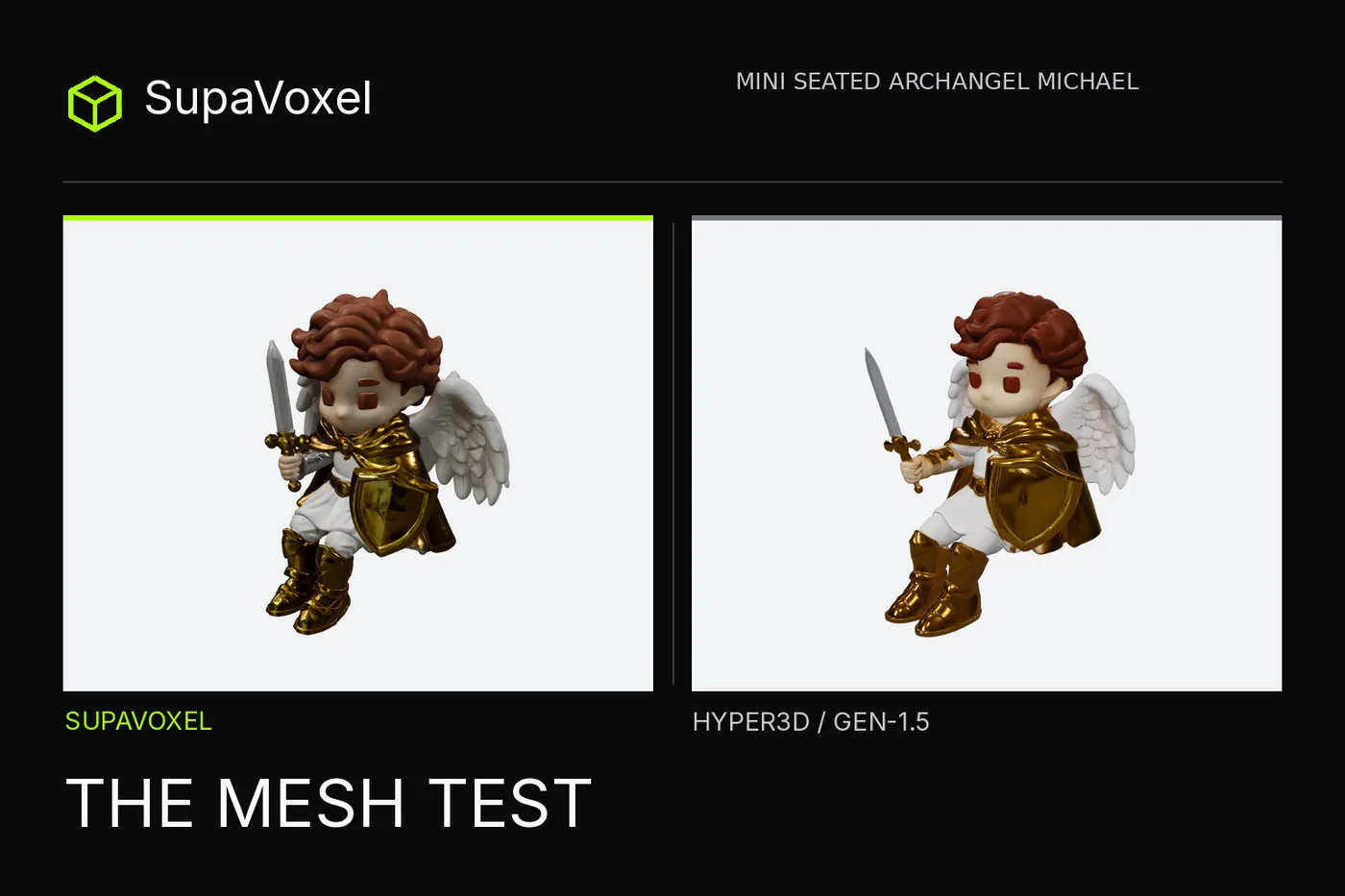
Independent review. I ran both tools on my own accounts, free and paid, with no vendor-provided access or early access of any kind.
I tested a brief for a little seated winged figure that someone might turn into a physical miniature. The photograph had curls, a sword, a gold shield and boots hanging off a ledge. It did not show the back. I gave that exact picture to Hyper3D and SupaVoxel, downloaded the files each account could actually export, and inspected the geometry beneath the attractive previews.
The answer depends on what I mean by “make.” A rotating digital close-up and a print-shop starting mesh are not the same commission.
My verdict in 60 seconds — for an unrepaired physical-print starting file, I would take Hyper3D Gen-1.5; for a digital rear-view close-up, SupaVoxel’s more articulated wings win. Hyper3D's downloadable Gen-1.5 mesh becomes one watertight, edge-connected shell with zero nonmanifold edges after UV-seam welding. SupaVoxel draws the invented back feathers more convincingly but has 471 nonmanifold edges and 315 face-connected regions. I would start the print preparation with Hyper3D. For a digital rear-view hero, I would choose the layered wings from SupaVoxel; that is a different brief, not a quiet reversal of the print verdict.
My eight-line decision card weighs the unrepaired print candidate. Each line pairs a measured check or visible observation with its practical consequence; none is a score for the whole platform:
- Welded watertight shell — Hyper3D yes, SupaVoxel no — only Hyper3D clears this prerequisite without an unmeasured repair.
- Nonmanifold edges — 0 vs 471 — 471 problem edges become the first SupaVoxel workshop task.
- Face-connected regions — 1 vs 315 — vertex-only touching is not the same as one coherent printable skin.
- Boundary edges — 0 vs 0 after welding — a genuine tie, not proof that both are watertight.
- Consistent winding — yes vs yes — another measured tie.
- Degenerate / sliver faces — 0 / 344 vs 0 / 20 — SupaVoxel wins this narrow triangle-hygiene check.
- Rear feather articulation — broad joined Hyper3D panel vs distinct SupaVoxel tiers — SupaVoxel wins the visible digital detail.
- Thin-part verification — no sword/wing thickness test on either file — neither earns a print-ready certificate.
The shell defect is a gate for an unrepaired print. More attractive feathers cannot cancel it. Both still need slicing and a physical test.
Did both tools receive the same picture?
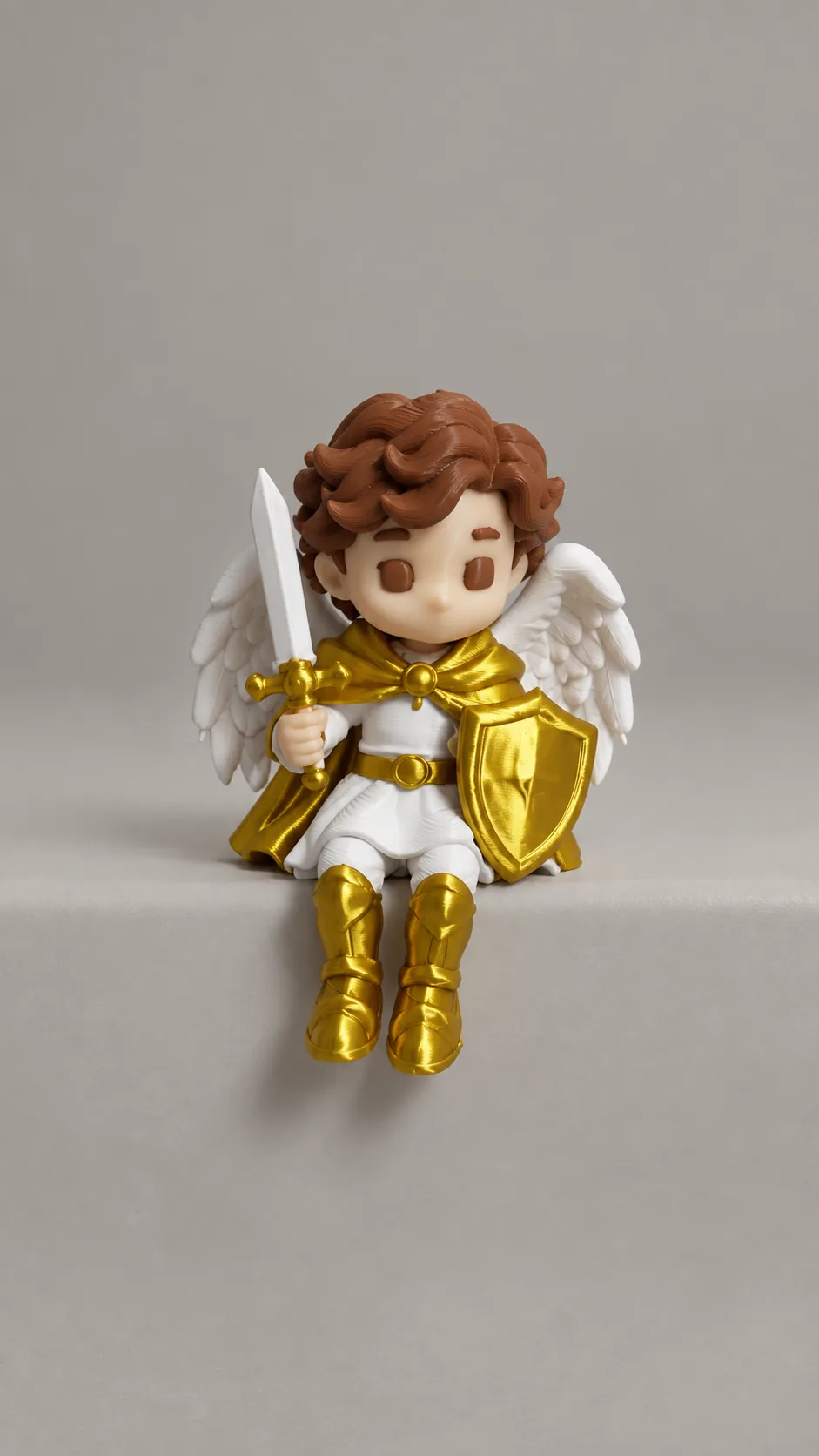
One independently generated 1,650,798-byte PNG went to both tools; no rear reference was supplied. Publication and reuse rights for the reference-influenced image still require review.
This was one image, one Hyper3D Gen-1.5 downloadable run and one SupaVoxel run. Hyper3D's additional Gen-2.5 trial is an access experiment, not the source of the file in these paired pictures. The same uploaded bytes do not mean the two systems performed identical internal image processing. My question is narrower: which delivered mesh would I hand to a person preparing this specific 120 mm-scale figure? If the figure sits on a shelf, somebody must also design its support or mounting. The photographed ledge was scenery; it was not evidence of a modeled display stand.
What survives when I inspect the two fronts?
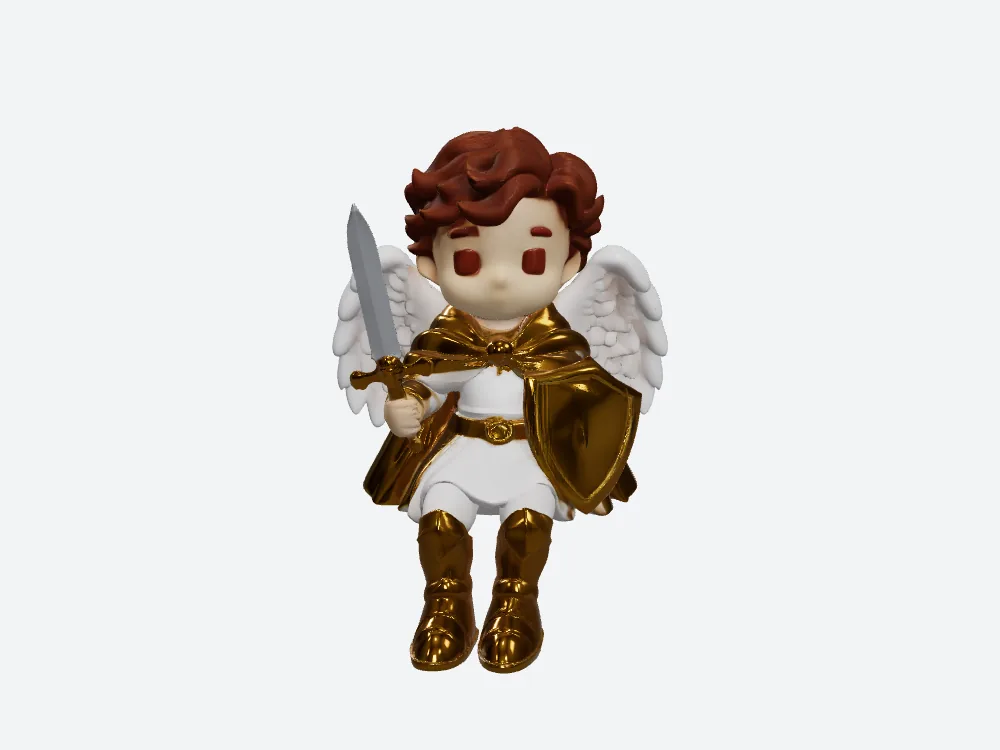
Hyper3D Gen-1.5 keeps the sword, shield, curls, both wings and hanging boots on a 120,000-triangle downloadable mesh.
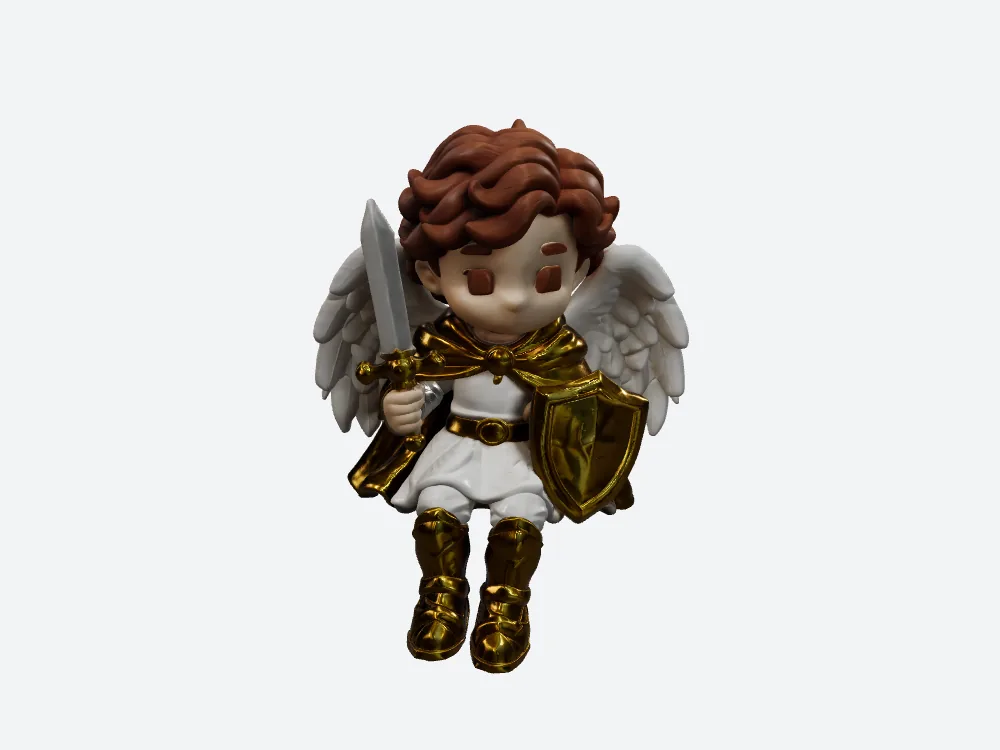
SupaVoxel's actual Original size GLB keeps the same recognizable props and stronger raised shield and feather forms at 946,166 triangles.
At thumbnail size these are both successful figures. The failure I care about doesn't announce itself in either front render. The SupaVoxel file has 7.88 times the triangles and 494,427 file vertices against Hyper3D's 114,101. That is more sampling capacity, not 7.88 times the likeness and not 7.88 times the usable print resolution. At a shared longest bounding-box side of 120 mm, SupaVoxel occupies 72.17 × 120 × 96.97 mm; Hyper3D occupies 91.56 × 120 × 88.33 mm. That is not a claim that both are exactly 120 mm tall in a maker's chosen orientation. My first practical step would be to inspect sword and wing-root cross-sections at the intended scale. Neither a beautiful preview nor those bounding boxes gives me a minimum wall thickness.
Why did I weld the mesh before counting holes?
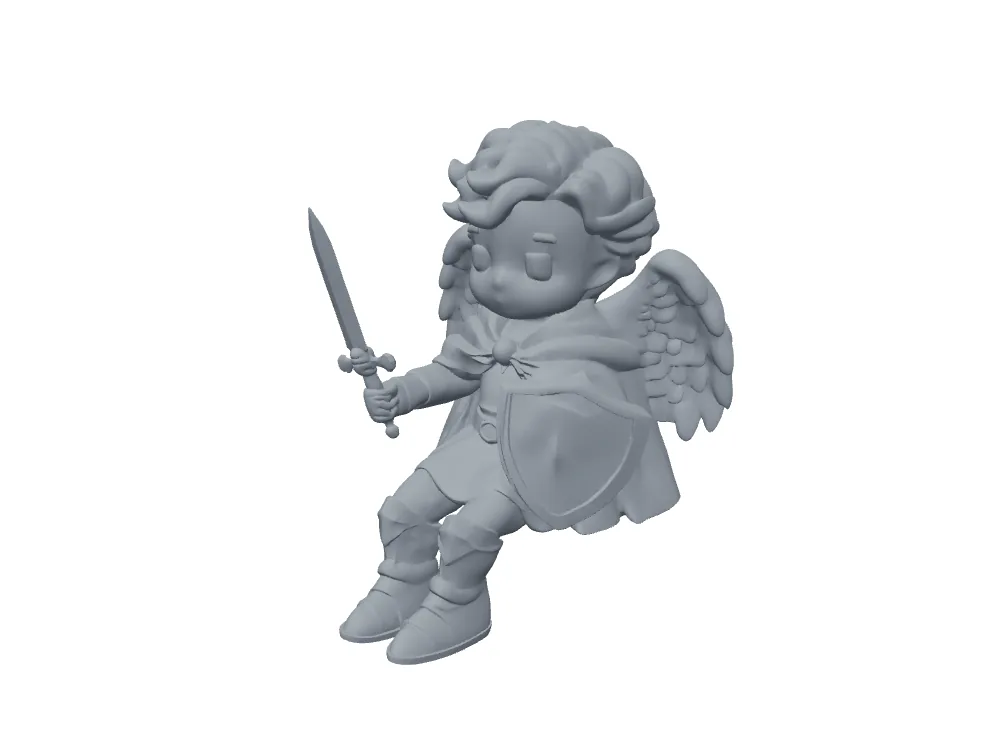
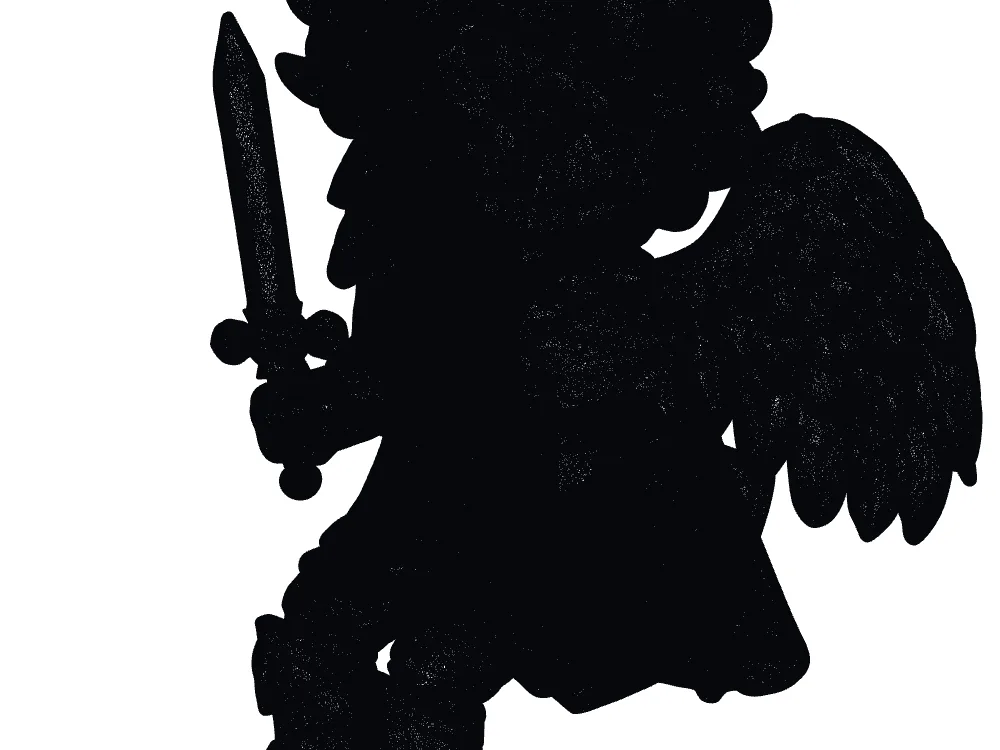
Removing Hyper3D's materials leaves a recognizable sword and wing silhouette; the topology result comes from file parsing, not this clay picture.
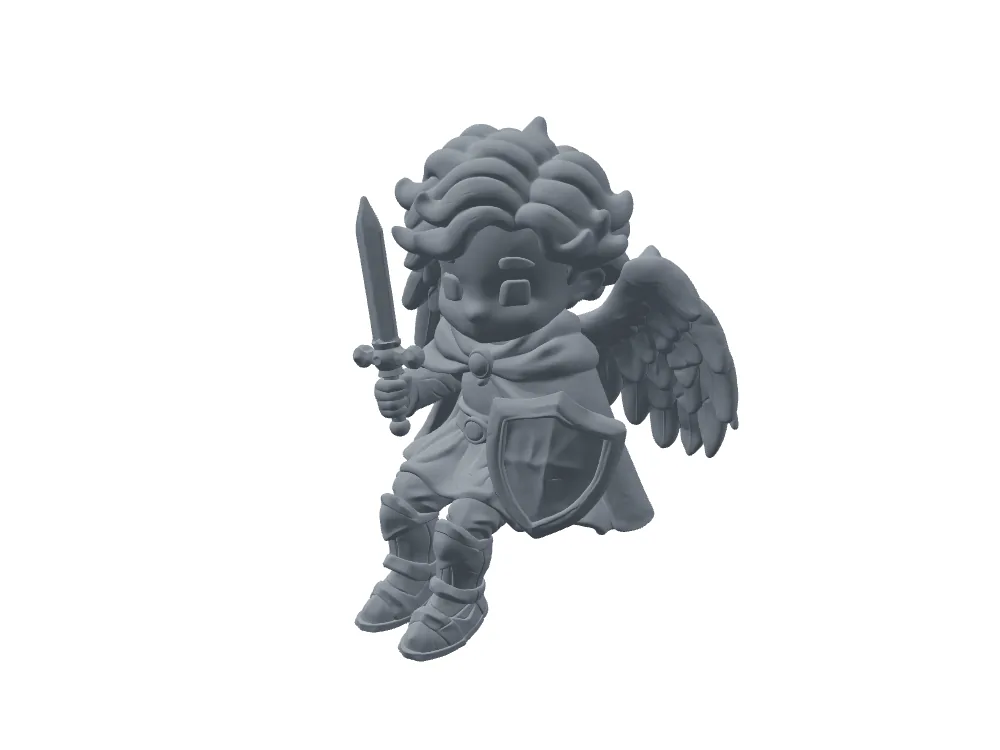
SupaVoxel still has visible shield and feather relief without paint; that relief does not close its nonmanifold edges.
A GLB may duplicate vertices along UV and normal seams. Counting those as open boundaries before welding would falsely describe a texture seam as a physical hole. After merging coincident seam vertices, Hyper3D is one face-connected shell, zero boundary edges, zero nonmanifold edges and consistent winding. SupaVoxel also has zero boundary edges and consistent winding. But it has 471 nonmanifold edges and 315 face-connected regions. If I permit surfaces touching at one vertex to count as connected, its component count falls to one. A corner touch does not give a slicer the same unambiguous solid as a shared, correctly oriented edge. That distinction is why the superficially similar “zero boundaries” line does not produce a print tie.
Do the rear wings make the extra repair worthwhile?
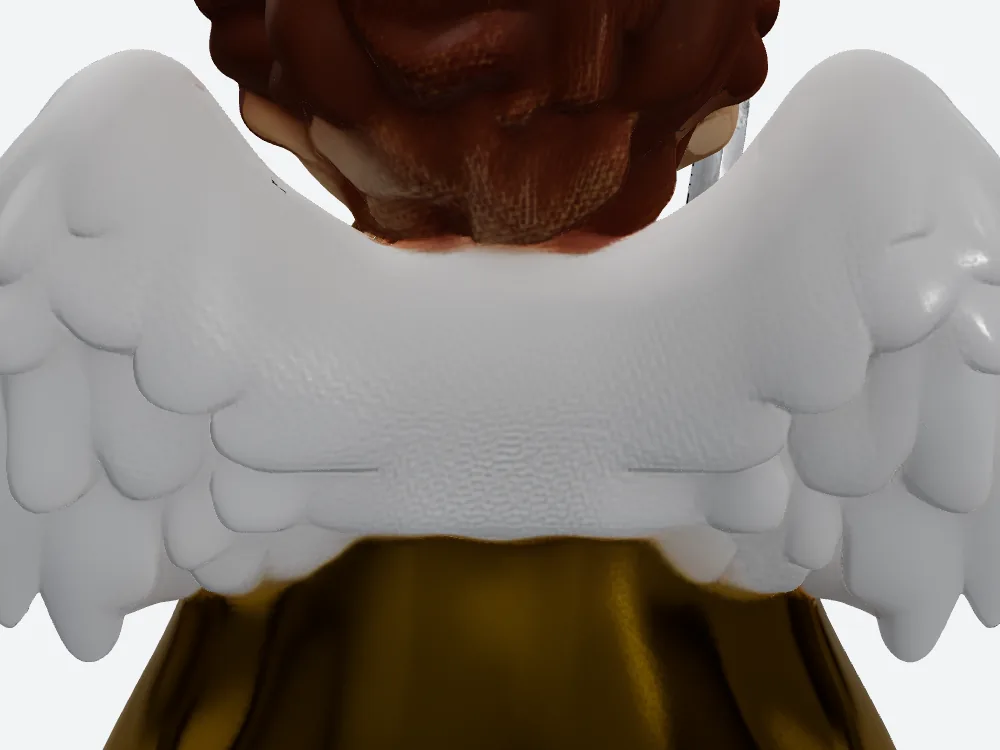
Hyper3D joins the wing roots into a broad central white panel; individual feather forms collect toward the sides.
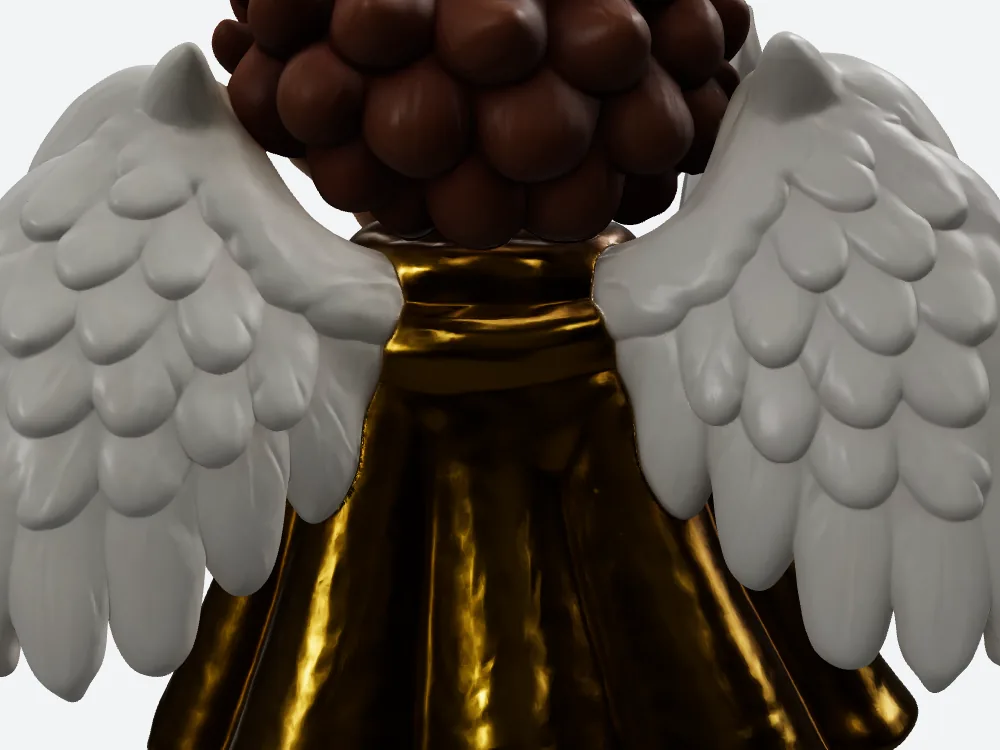
SupaVoxel leaves the gold collar visible between two wings and lifts several feather tiers into separate silhouettes.
Yes, if the commission is a rotating digital collectible whose back fills the frame. This is SupaVoxel's clearest win in the pair. I cannot call either back faithful because the input contains no back. I can call the delivered SupaVoxel back more articulated in these matched renders. The exchange rate is unusually concrete: for that rear close-up I accept a 36.59 MB Original size GLB instead of a 15.25 MB extracted Hyper3D PBR GLB, and, if the object must become physical, an unmeasured repair of 471 nonmanifold edges before trusting a solid-volume or resin estimate. I would happily pay that file-and-edit cost for a digital hero. For a time-sensitive print I would not swap an already coherent shell for prettier invented plumage without actually performing and validating the repair.
Does the wireframe certify a printable sword?
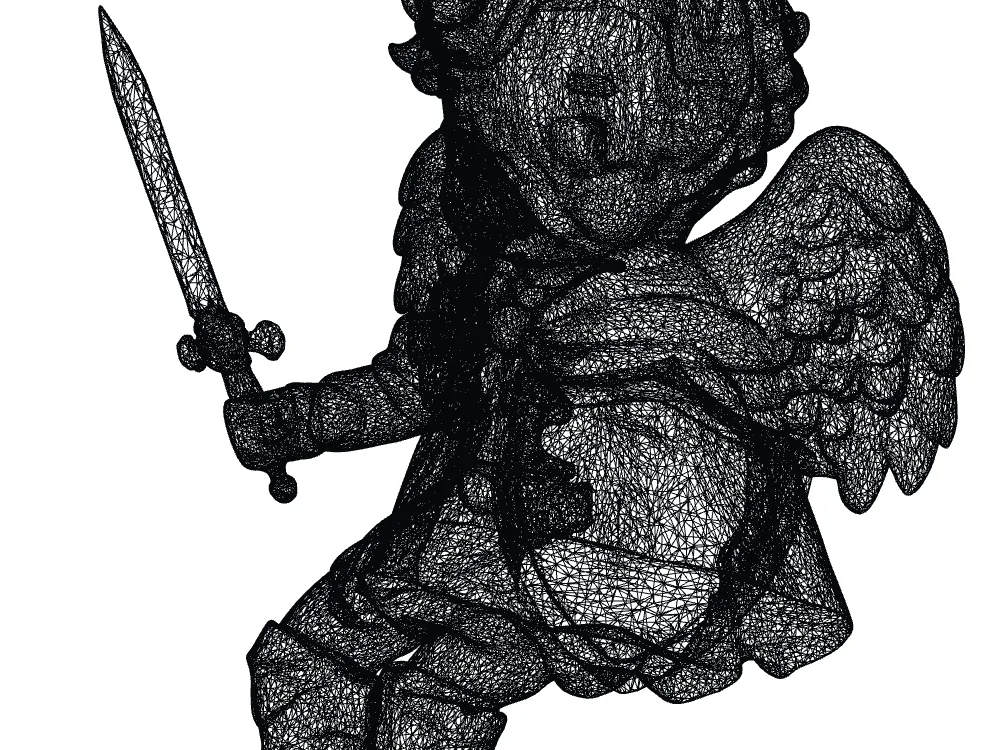
The Hyper3D wire view shows where the 120,000 triangles sit; 344 are long-thin under the common check.
SupaVoxel's denser 946,166-triangle wire view contains just 20 long-thin faces, but the line tangle cannot diagnose 471 nonmanifold edges by eye.
At the 120 mm longest-side normalization, estimated mean triangle edge length is 0.8304 mm vs 0.3283 mm. A 0.4 mm FDM nozzle offers a familiar scale reference; it does not mean every 0.3283 mm edge survives printing, nor that a sword blade is at least 0.4 mm thick. SupaVoxel earns its win on the narrow sliver check, 20 against 344, and both meshes have zero degenerate faces. Hyper3D wins the more basic shell-integrity gate. In the shop I would first repair the SupaVoxel defects, then check local blade thickness and supports on both. Buying more mesh samples does not buy that second inspection.
How much downward-facing surface did the screening flag?

Hyper3D's side view exposes a thin wing profile, sword and suspended boots; none was measured for strength.
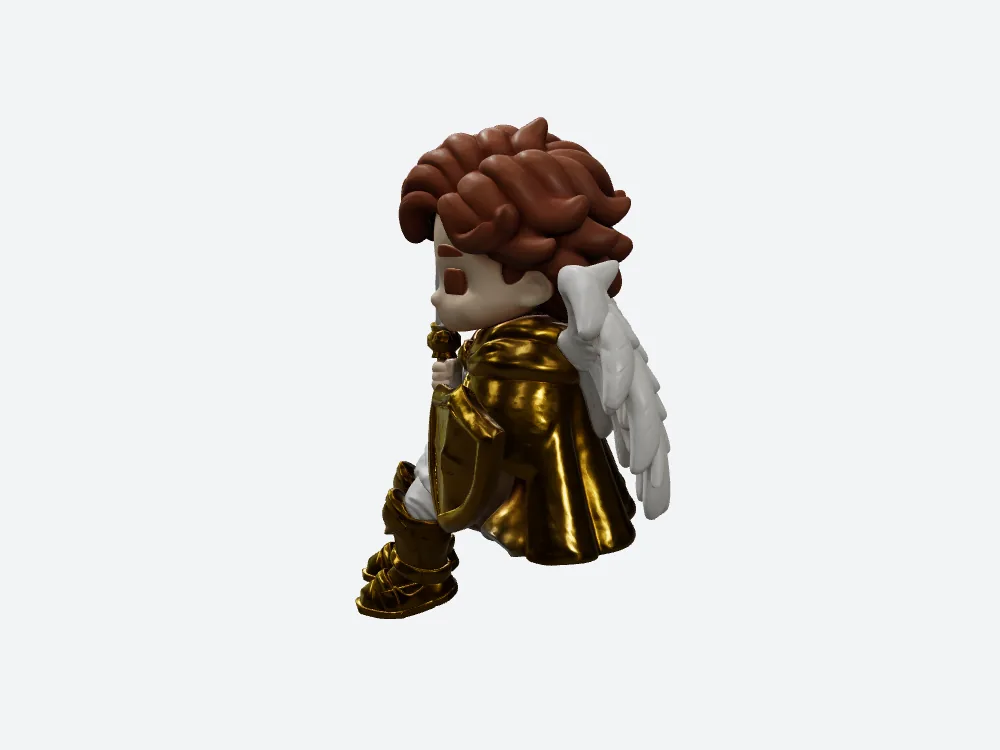
SupaVoxel's wings look more voluminous at the paired angle; this is not a measured reduction in required supports.
Under one deliberately simple screen—world Y up, faces pointing within 45 degrees of downward −Y, same 120 mm longest-side scale—I count 5,458.3 mm² potentially downward-facing area for Hyper3D and 5,588.2 mm² for SupaVoxel. Their fractions are 16.58% and 15.27% because their total surfaces differ. The SupaVoxel absolute area is 129.9 mm² higher while its percentage is lower: neither number is a slicer's support volume. Turn the winged figure on the bed and both change. If someone reads this as “SupaVoxel saves support resin,” they have swapped an orientation screen for a manufacturing trial. I did not generate supports, slice or print either object.
Can I quote a resin bill for both models?
No. Hyper3D's welded mesh passes the shell checks required for an enclosed-volume estimate: 181.75 cm³ at the shared 120 mm longest-side normalization. A hypothetical completely solid pour at $35/L gives $6.36 before hollowing, support, waste and failure. SupaVoxel's broken topology does not provide a validated enclosed volume, so I will not put a dollar figure beside its entry. The apparent signed volume of an uncorrected file is not a resin invoice. That missing comparison is not a rhetorical trick; I would need to repair the specific file and recalculate the solid. If the real job is a hollow resin figurine, neither the $6.36 number nor a purely visual feather win predicts the amount of consumable material.
Did the product screens deliver these actual files?
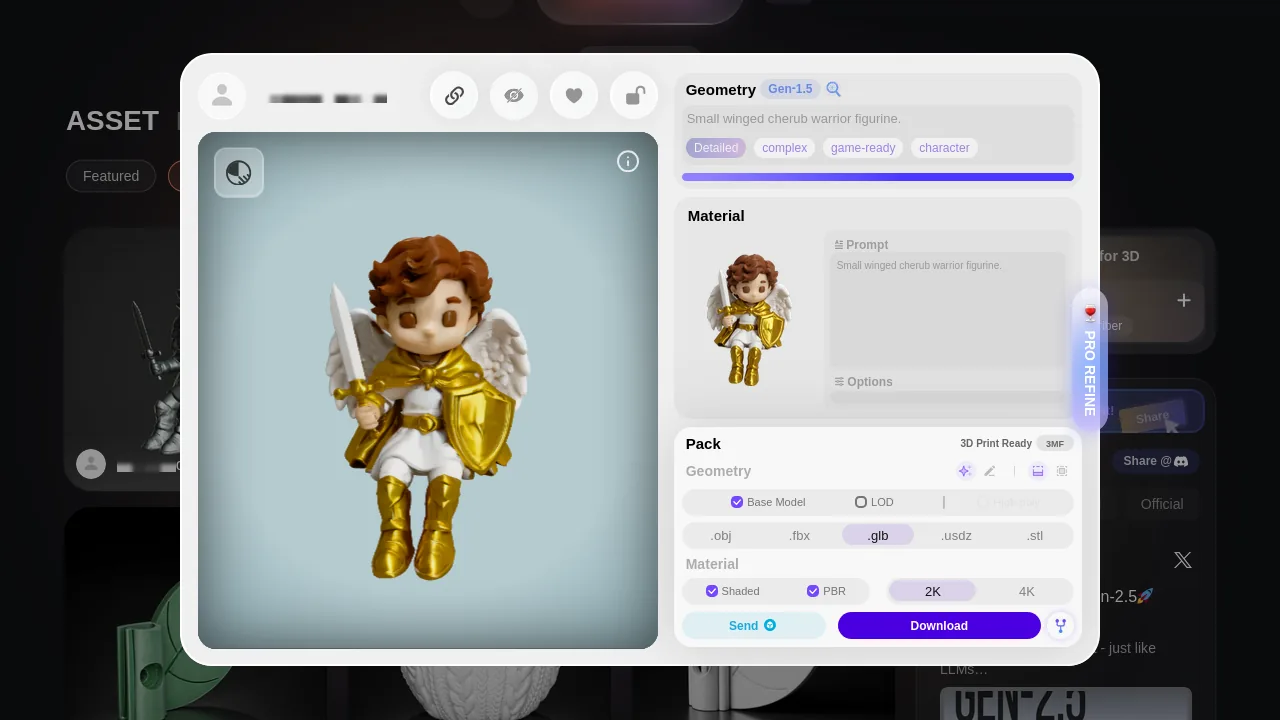
The successful Hyper3D Gen-1.5 export selected GLB, Shaded and PBR at 2K; the browser delivered a ZIP with both variants.
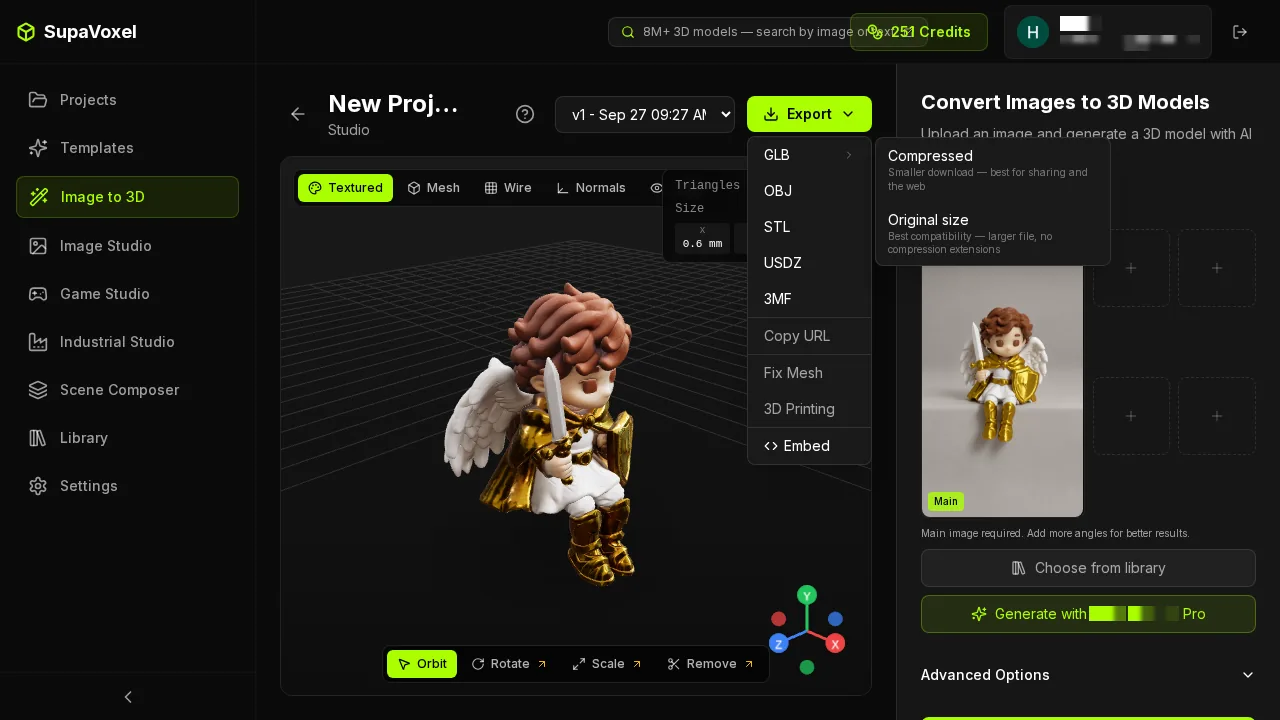
The measured SupaVoxel branch is GLB → Original size. The offered Compressed option was not measured here.
The Hyper3D file inspected above is the 15,247,868-byte PBR member extracted from its actual 24,544,968-byte browser ZIP. The first legally downloaded geometry-only Hyper3D GLB was 5,092,448 bytes without embedded textures; I did not compare that blank-stage file with SupaVoxel's colored output. SupaVoxel's file is a real 36,589,892-byte Original size browser export, not a mislabeled CDN asset. At a purely hypothetical 12 Mbps, their actual UI delivery payloads imply 16.36 and 24.39 seconds of ideal transfer respectively. Hyper3D has a genuinely lighter handoff; SupaVoxel's visible feather advantage is therefore not free in either bytes or topology. The menu's Fix Mesh entry was present, but I did not run it, and a button is not a completed repair.
What happened before Hyper3D made the downloadable mesh?
Hyper3D Gen-2.5 showed a million-face preview, spent an isolated 0.5 Hyper3D credit, and refused its free-account download with a subscription prompt. No Gen-2.5 GLB was available for my geometry checks. I switched to a different Gen-1.5 generation: free preview 25.064 seconds, geometry confirmation 14.299 seconds and another 0.5 Hyper3D credit, with separately verified zero extra credit for Material Generate and Material Confirm in this run. Those known 39.363 seconds omit material, operator time and download. SupaVoxel's matched request lasted 193.746 seconds between database timestamps including queue but excluding upload and export; its transaction was 3 SupaVoxel credits. These are not exchangeable currencies or equivalent stopwatches. The interrupted browser gap before finishing Hyper3D's Gen-1.5 confirmation was operator downtime, not nine hours of generation.
Which one would I put on my shop ticket?
If the ticket says “unrepaired starting shell for a 120 mm-class physical miniature,” Hyper3D Gen-1.5 wins this sample. Zero nonmanifold edges versus 471 is a gate, not a fussy aesthetic preference. I would still inspect the sword, wing roots, mounting and thin details in a slicer before authorizing a print. If it says “spinning character in a digital storefront with a rear close-up,” SupaVoxel wins the visible feather treatment, and its larger file and need for eventual physical repair may be tolerable. If the back never appears, the extra feather articulation may buy nothing. We have one example, no print, no completed repair and no empirical failure rate; those are constraints on how far this decision travels, not reasons to pretend the two delivered files are equal.
Final verdict: why did the print starter go to Hyper3D?
Because the topology really did. The Hyper3D downloadable Gen-1.5 PBR mesh was a watertight, consistently wound, single edge-connected shell after fair UV welding. The SupaVoxel mesh was not, despite a better-looking invented back and excellent sliver count. That is the actual rival win and its exchange rate: a 21.34 MB smaller standalone PBR GLB and no measured manifold repair, in return for a conspicuously flatter central wing span. I would not tell a maker that a visually superior back erases an unresolved solid; nor would I tell a digital artist that an ideal shell erases an obvious rear-view flattening.
Use SupaVoxel when the back is the deliverable
If your deliverable is a textured rotating figure rather than an unrepaired print file, put your own winged reference through SupaVoxel and inspect the back and clay view before choosing. In this one paired run its raised feather tiers are the reason to choose it. If that same file has to become a miniature, make mesh repair and a real slicer/print test explicit stages; the original file's 471 nonmanifold edges are not a detail to hide from the fabricator.
How I tested it. Same independent source PNG and no back reference; different products' actual downloaded textured GLBs measured offline, with matched preset camera and light. The SupaVoxel render's yaw was adjusted 90° to present the front like the reference; matched views compare subjects, not pixel-registered reconstructions. Parsed file counts and welded topology are measurements. Averages at 120 mm, transfer seconds and $35/L solid-fill resin are stated-assumption calculations. Back-wing quality is my judgment from paired renders. Local thickness, support generation, slicing, actual print behavior, publisher rights to the reference-influenced input and repeated-run reliability remain untested.
Originally published on Medium: Hyper3D Figurine Review 2026: A Solid Shell With Flattened Wings.